Abstract
This study examined the determinants of the Level of Participation among smallholder rice farmers in agricultural programmes in Ayamelum Local Government Area of Anambra State, Nigeria. A multi-stage sampling technique was employed to select 100 rice farmers from five communities. Primary data were collected using structured questionnaires. Descriptive statistics were used to analyze farmers’ socio-economic characteristics and participation levels, while multiple regression analysis was applied to identify the factors influencing participation. The findings reveal that participation is a multi-dimensional behavioral outcome shaped by the interaction between farmers’ internal capacities and external environmental conditions. Socio-economic factors such as educational qualification, age, income, farm size, and household size represent the foundational drivers of farmers’ readiness to engage in agricultural programmes. However, institutional and spatial factors including access to credit, availability of funds, access to extension services and information, and distance to programme centres significantly moderate the level of participation. In particular, limited financial resources and long distances to programme centres were identified as major structural constraints that reduce effective engagement. The regression results confirmed that while human capital enhances participation potential, institutional support and geographical proximity determine actual involvement. The null hypothesis was therefore rejected. The novelty of this study lies in its integrated Socio-Spatial-Institutional framework, which empirically demonstrates how geographical distance and financial barriers can offset strong socio-economic capacity. The study recommends decentralizing programme centres, expanding accessible credit facilities, and strengthening extension services to enhance and sustain farmers’ participation in agricultural programmes.
Keywords
Agricultural Programmes, Farmer Participation, Socioeconomic Factors, Rice Farmers, Smallholder Farmers
1. Introduction
Agriculture plays a critical role in the economy of Nigeria by providing employment, food, raw materials for agro-industries and foreign exchange earnings. Despite a decline in output, the sector has consistently contributed an average of 24% to Nigeria's Real GDP from 2012 to 2018
. Nigeria has implemented various agricultural and rural development policies and programs over the years such as Operation Feed the Nation (OFN), the Green Revolution Programme (GRP), the National Fadama Development Project, and more recently the Anchor Borrowers’ Programme (ABP), aimed at revitalizing agricultural production and improving rural livelihoods yet it continues to grapple with challenges related to food insecurity and rural poverty
| [4] | Akarowhe, K. (2018). Retooling agricultural policies and programmes for sustainable in Nigeria. Journal of Current Investigations in Agriculture and Current Research. 1(2). |
| [14] | Noko, E. J. (2017). Impact of Agricultural sector on Nigerian Economic growth and development Appraisal Report, 2003. Republic of Nigeria, Fadama Development Project. |
[4, 14]
. Longinus & Gomathy (2016) noted that every attempt by successive governments and international donor agencies to alleviate poverty in Nigeria has thus far been unsuccessful
| [11] | Longinus, C. E. & Gomathy, P. (2016). Poverty Reduction through Agricultural Improvement and access to Credit: A Confirmation from the Small-holder Farmers in Anambra state, Nigeria. Journal of Sustainable Development in Africa (Volume 18, No. 3, 2016). Clarion University of Pennsylvania. Clarion, Pennsylvania. |
[11]
. Despite the consistent launch of agricultural and rural development programs by successive governments, the tangible impact of these initiatives on the livelihoods of the beneficiaries remains uncertain. Rice (Oryza sativa) has emerged as a major staple and cash crops in the Nigerian economy and dietary preferences, contributing about 10.5% of average caloric intake
| [7] | FAO (Food and Agriculture Organisation). (2019). The Participatory Approach to Agricultural Development. Pp. 10-12. |
[7]
. Rice is a vital commodity for food security in Nigeria and globally
| [12] | Mohidem, N. A., Hashim, N., Shamsudin, R. & CheMan, H. (2022). Rice for food security: Revisiting its Production, Diversity, Rice Milling Process and Nutrient Content. Agriculture, 12(6), 741. |
[12]
. The country's increasing population, rapid urbanization, and changing dietary habits have led to a faster growth in rice consumption compared to other staple crops. In West Africa, rice is the primary source of dietary energy and ranks third in importance for the whole African continent
| [21] | Seck, P. A., Fiamohe, R., Nakelse, T. and Diagne, A. (2013). Assessing the effect of consumer purchasing criteria for types of rice in Togo: A choice modeling approach. The 4th International Conference of the African Association of Agricultural Economists, September 22-25, 2013, Hammamet, Tunisia. 1-20. |
[21]
. Globally, it is the second most produced crop after maize, and in 2017, Nigeria held the highest position as the largest producer and consumer of rice in West Africa
| [6] | Cadoni P, Angelucci F. (2017). Analysis of incentives and disincentives for rice in Nigeria Technical notes series MAFAP, FAO, Rome. 2017. |
[6]
. Despite its significance, Nigeria has not been able to meet the domestic demand for rice through local production, leading to heavy reliance on international markets and substantial foreign exchange expenditures. Ayamelum local government is one of the local government areas in Anambra State that produces rice but despite it recognition as a rice producing local government, these farmers face multiple challenges, including limited access to credit, extension services, improved inputs, reliable information, and markets
| [15] | Nsikan, B. (2023). Analysis of credit access and utilization among palm fruits processors in Abak Agricultural Zone, Akwa Ibom State. AKSU Journal of Agricultural Economics and Development, 6(1). |
[15]
.
1.1. Objectives of The Study
The specific objectives of this research were to describe the socioeconomic characteristics of smallholder rice farmers in Ayamelum Local Government Area, focusing on demographic variables such as gender, age, household size, and educational attainment to establish a profile of the farming population. Furthermore, the study determined the participation levels of these farmers across various agricultural programmes, including the IFAD-Value Chain Development Programme, the Fadama Development Project, the Agricultural Transformation Agenda, the Anambra State Agricultural Development Programme, and the Community-Based Agricultural and Rural Development Programme. Finally, the study analyzed the socioeconomic and institutional factors influencing participation by testing the relationships between farmer engagement and key determinants such as educational qualification, information access, geographical distance to programme centers, and availability of credit facilities.
1.2. Theoretical Framework
This study was anchored in the Innovation Diffusion Theory (IDT) and the Theory of planned Behavior (TPB)
| [3] | Ajzen, I. (1991). The Theory of Planned Behavior. Organizational Behavior and Human Decision Processes, 50, 179-211.
https://doi.org/10.1016/0749-5978(91)90020-t |
| [20] | Rogers, E. M. (2003). Diffusion of Innovations (5th ed.). Free Press. |
[3, 20]
. The IDT posits that “innovativeness” is a result of human capital, suggesting that farmers with higher education and experience are more likely to participate in new interventions. This framework directly supports the hypothesis that individual characteristics act as the primary internal filters for program adoption. The TPB explains the variance in participation levels and influence of external constraints. It suggests that participation is driven by “Perceived Behavioral Control,’ which is tested with the hypothesis that institutional factors such as credit access, information flow, and geographical distance are essential determinants of behavior. As noted by
| [18] | Omotesho, K. F., Ogunlade, I., Muhammad-Lawal, A. & Kehinde, F. B. (2016). Determinant of Level of Participation of Farmers in Group Activities in Kwara State, Nigeria. Journal of Agricultural, Faculty of Gaziosmanpasa University (JAFAG), 33(3): 21-27. http://Ziraatdergi.Gop.Edu.Tr/ |
[18]
, when these institutional barriers are high, they significantly diminish a farmer's intention to engage. By integrating these theories, the study evaluates how the intersection of internal capacity and external facilitators dictates the success of agricultural programs in Ayamelum LGA.
1.2.1. The Role of Socioeconomic Factors in Innovation Diffusion
As posited by
| [20] | Rogers, E. M. (2003). Diffusion of Innovations (5th ed.). Free Press. |
[20]
in the Innovation Diffusion Theory, the socioeconomic variables such as education and farming experience act as cognitive filters that allow the farmers to ascertain the technical complexity and relative advantage of agricultural programs. While, the variables such as farm size and monthly income determines a farmers’ risk bearing capacity with those with higher income level theoretically positioned as early adopters.
1.2.2. Institutional Dynamics and Perceived Behavioral Control
The theory of Planned Behavior by
best explain the impact of institutional factors such as access to extension services, information flow and credit availability. Participation in the agricultural programme is anchored on the “Perceived Behavioral Control,” the extent to which the farmer feels they have the required resources to succeed. According to
| [8] | Jamilu, A. A., Atala, T., Akpoko, J., & Sanni, S. (2015). Factors Influencing Smallholder Farmers Participation in IFAD-Community Based Agricultural and Rural Development Project in Katsina State. Journal of Agricultural Extension, 19(2), 93.
https://doi.org/10.4314/jae.v19i2.8 |
[8]
, the absence of institutional support such as credit or extension services hinder farmers from actually participating in agricultural programme despite its importance.
1.2.3. Spatial Factors and Transaction Cost Theory
The inclusion of distance to the Programme centre as a spatial factor is anchored in the Transaction Cost Theory. As noted by
| [18] | Omotesho, K. F., Ogunlade, I., Muhammad-Lawal, A. & Kehinde, F. B. (2016). Determinant of Level of Participation of Farmers in Group Activities in Kwara State, Nigeria. Journal of Agricultural, Faculty of Gaziosmanpasa University (JAFAG), 33(3): 21-27. http://Ziraatdergi.Gop.Edu.Tr/ |
[18]
, spatial proximity is a critical determinant of participation of farmers in agricultural programme because it dictates the ease of access to inputs and training sessions. In rural rice-producing regions, increased distance often functions as a "participation tax," where the cost of reaching the program center outweighs the subsidies or benefits offered by the intervention.
1.2.4. Participation Intensity
The Level of Participation serves as the dependent variable that reflects the cumulative effect of the aforementioned drivers. Participation is viewed as a behavioral response to the synergy between a farmer's internal socio-economic capacity and the external institutional/spatial environment. The Nexus between Socioeconomic, Institutional and Spatial Determinants and Participation Levels.
The level of participation depends on how socio-economic factors (such as education, age, income, and farm size), institutional support (like access to extension services, information, and credit), and spatial factors (such as distance to the programme centre) work together. Farmers with better education and income have greater capacity to participate, but their involvement is strengthened by good institutional support and reduced by barriers like limited credit or long distances. Therefore, participation increases when the environment supports farmers’ abilities and decreases when institutional and spatial challenges outweigh their personal capacity.
1.2.5. Thus, the Central Hypothesis of This Study Was as Follows
There is no significant relationship between the socio-economic, institutional, and spatial factors (educational qualification, age, lack of funds, farm size, monthly income, access to extension, access to information, household size, limited credit access, and distance to program centers) and the level of participation of rice farmers in agricultural programmes in Ayamelum Local Government Area.
1.3. Conceptual Framework
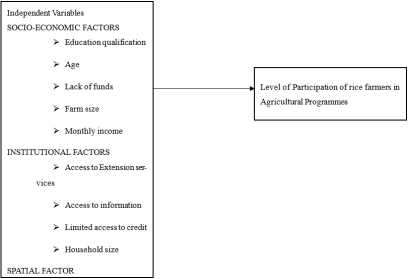
As shown in
Figure 1, the conceptual framework illustrates how socio-economic, institutional, and spatial factors jointly influence the level of participation among rice farmers. It emphasizes that farmers’ decisions to participate in agricultural programmes result from the interaction between their personal capacity and the external conditions surrounding them.
This relationship is supported by two complementary theories. The Innovation Diffusion Theory (IDT) explains that socio-economic factors such as education, age, and income determine a farmer’s readiness to adopt new ideas or programmes. Meanwhile, the Theory of Planned Behavior (TPB) highlights that institutional factors (credit, extension, and information) and spatial factors (distance) shape participation by affecting farmers’ perceived ability to engage. Thus, even when farmers have strong personal capacity, participation may remain low if external barriers such as limited credit access or long distances restrict their involvement.
Figure 1. Factors Affecting Participation of Rice Farmers in Agricultural Programmes.
The conceptual framework illustrates the determinants of rice farmers’ participation in agricultural programmes by grouping the explanatory variables into three major blocks: socio-economic factors, institutional factors, and spatial factors. These independent variables jointly influence the dependent variable participation of rice farmers in agricultural programmes.
The work of
| [8] | Jamilu, A. A., Atala, T., Akpoko, J., & Sanni, S. (2015). Factors Influencing Smallholder Farmers Participation in IFAD-Community Based Agricultural and Rural Development Project in Katsina State. Journal of Agricultural Extension, 19(2), 93.
https://doi.org/10.4314/jae.v19i2.8 |
[8]
, on the factors influencing Smallholder Farmers Participation in IFAD-Community Based Agricultural and Rural Development Project in Katsina State, logit regression analysis was used to analyze the data. The results showed that level of education, household size, farm size, membership of cooperative and extension contact were the factors influencing smallholder farmers’ participation in the project. In the work of
| [18] | Omotesho, K. F., Ogunlade, I., Muhammad-Lawal, A. & Kehinde, F. B. (2016). Determinant of Level of Participation of Farmers in Group Activities in Kwara State, Nigeria. Journal of Agricultural, Faculty of Gaziosmanpasa University (JAFAG), 33(3): 21-27. http://Ziraatdergi.Gop.Edu.Tr/ |
[18]
, the Ordinary Least Square (OLS) regression analysis was the analytical tool used for the study. The results revealed that total annual income, farm size, number of extension contact, membership of farmer groups, access to credit and access to training influenced farmers participation in farmer-groups.
| [2] | Agwu, N. M., Nwankwo, E. E. & Anyanwu C. I. (2017). Determinants of agricultural labour participation among Youths in Abia State, Nigeria. International Journal of Food and Agricultural Economics, 2(1), 157-164. |
[2]
, employed the probit regression model to analyse the determinants of agricultural labour participation among youths in Abia State, Nigeria. The results showed that the coefficients of education of the respondents, income from nonagricultural sources, occupation of the parents, education of the father, farm size and the rate of mechanization influenced agricultural labour participation among the youths in the study area. Apart from the coefficient of farm size that had a positive sign, the other variables had negative relationship.
| [1] | Adesina, T. K. & Eforuoku, F. (2016). Determinants of participation in youth-in-agriculture programme in Ondo State, Nigeria. Journal of Agricultural Extension, 20(2), 104-117.
http://dx.doi.org/10.4314/jae.v20i2 |
[1]
, employed multiple regression analysis to analyse the determinants of participation in Youth-in-Agriculture Programme (YIAP) in Ondo State. Results revealed that predictors significantly related to YIAP participation were household size, farm size, years of farming experience, attitude, and constraints while farm size and years of participation mostly contributed to participation in YIAP.
Existing studies on farmers’ participation in agricultural programs largely focus on cooperatives or large-scale interventions in Northern and Southwestern Nigeria, leaving a gap in localized, rice-specific evidence at the local government level particularly in Ayamelum LGA of Anambra State on the factors influencing smallholder farmers’ decisions to participate or not participate in agricultural programs.
2. Methods and Materials
2.1. Study Area
The study was conducted in Ayamelum Local Government Area (LGA) of Anambra State, Nigeria, with a focus on factors influencing farmers’ participation in agricultural extension training programmes. Ayamelum LGA is one of the twenty-one local government areas in Anambra State, located in the south-eastern region of Nigeria. Anambra State is bordered by Delta State to the west, Imo State to the south, Enugu State to the east, and Kogi State to the north. The state lies between longitudes 6°35′E and 7°21′E and latitudes 5°38′N and 6°47′N
| [13] | National Bureau of Statistics (NBS). (2022). Agricultural Sector Performance in Nigeria Report 2021/2022. Abuja: NBS Press. |
[13]
.
Anambra State has an estimated population of about 9 million people and is predominantly inhabited by the Igbo ethnic group. Ayamelum LGA covers a land area of approximately 207.6 square miles and has an estimated population of 225,400 inhabitants. The administrative headquarters of Ayamelum is located in Anaku. The LGA is strategically positioned along the boundary between Anambra and Enugu States and is well known for its agricultural activities, particularly food crop production.
The major communities that make up Ayamelum LGA include Omor, Umueje, Omasi, Igbakwu, Umumbo, Anaku, Umuerum, and Ifite Ogwari. The area possesses considerable agricultural and economic potential, providing employment opportunities and serving as a major food-producing zone within the state.
2.2. Sampling Technique and Sample Size
This study adopted a cross-sectional survey research design, which is appropriate for examining factors influencing smallholder rice farmers’ participation in agricultural programs at a specific point in time. The design allows for the collection of quantitative data from a representative sample of farmers and facilitates the use of regression techniques to analyze relationships between participation and selected socio-economic and institutional variables.
The respondents for this study were smallholder rice farmers in Ayamelum Local Government Area (LGA), Anambra State, selected because Ayamelum is one of the major rice-producing areas in the state and hosts several agricultural intervention programs. Focusing on this group was essential to generate context-specific evidence on participation behavior in agricultural programs.
Given the large and dispersed population of rice farmers in Ayamelum LGA, a multi-stage sampling technique was employed to ensure efficiency, representativeness, and cost-effectiveness.
In the first stage, purposive sampling was used to select five communities Omor, Ifite Ogwari, Umumbo, Omasi, and Anaku. These communities were deliberately chosen based on the presence and intensity of agricultural activities and program implementation. The justification for purposive sampling at this stage lies in the need to focus on areas where agricultural programs are actively implemented, ensuring that respondents had adequate exposure to such programs and could meaningfully provide information on participation decisions. This approach is widely supported in agricultural and development studies where specific characteristics of the study area are critical to achieving research objectives.
In the second stage, simple random sampling was employed to select farmers from each of the five communities. This helped to minimize selection bias and ensured that every eligible farmer had an equal chance of being selected. Both registered and unregistered farmers were included to capture variations in participation status.
A total sample size of 100 farmers was selected, comprising 20 farmers from each of the five selected communities. This sample size was considered adequate based on the relatively homogeneous nature of the farming population and the need for balanced representation across communities. Furthermore, the sample size satisfies the minimum requirements for regression analysis, where reliable estimates can be obtained when the number of observations sufficiently exceeds the number of explanatory variables included in the model. The equal allocation across communities also ensured comparability and avoided dominance of responses from any single location.
Primary data were collected using a well-structured questionnaire administered to the selected respondents. The questionnaire was designed to elicit information on farmers’ socio-economic characteristics, farm-level attributes, access to institutional services (such as extension and credit), awareness of agricultural programs, and participation status.
The questionnaire was adapted from previous empirical studies on farmers’ participation in agricultural programs and cooperative organizations
| [5] | Awotide, B. A., Awoyemi, T. T., & Fashogbon, A. (2015). Factors influencing smallholder farmer’s participation in cooperative organization in rural Nigeria. Journal of Economics and Sustainable Development. Vol. 6, No. 17, 2015. |
| [17] | Ogunjobi, V. O., Ojo, O. J. & Adebambo, H. O. (2022). Factors Determining Participation of Farmers in Agricultural Projects: Evidence From Usaid Markets Ii Project In Southwest Nigeria. Quest Journals Journal of Research in Agriculture and Animal Science Volume 9 ~ Issue 7 (2022) Pp: 01-07 I. |
| [19] | Orji, P. O., Shuaibu, H., Jamilu A. A., Ojeleye, O. A., Burabe, B. I. & Oyewole, S. O. (2024). Determinant of Factors Influencing the Participation of Smallholder Rice Farmers under Anchor Borrowers Programme in Kaduna State, Nigeria. Journal of Agricultural and Env. Science Res. JAESR Vol. 6(1). |
[5, 17, 19]
, with modifications made to suit the local context and objectives of the present study.
2.3. Method of Data Analysis
Data collected for the study were analysed using both descriptive and inferential statistical techniques. Descriptive statistics, including frequency counts, percentages and means analysis, were used to analyse objectives (i) and (ii). Objective (iii) was analysed using inferential statistics, specifically multiple regression analysis, to identify the key factors influencing farmers’ participation in agricultural programmes.
2.4. Model Specification
Yi=β0+β1X1i+β2X2i+β3X3i+β4X4i+β5X5i+β6X6i+β7X7i+β8X8i+β9X9i+β10X10i+εi
where:
Y = Level of participation of rice farmers in agricultural programmes
X1 = Educational qualification
X2 = Age (years)
X3 = Lack of funds
X4 = Access to extension services
X5 = Farm size
X6 = Access to information
X7 = Monthly income
X8 = Distance to agricultural programme centre
X9 = Household size
X10 = Limited access to credit facilities
ε = Error term
The normality of data was confirmed using the Kolmogorov-Smirnov and Shapiro-Wilk tests, ensuring the variables followed a distribution suitable for parametric analysis. To establish instrument reliability, Cronbach’s Alpha was computed, yielding a score of 0.82, which significantly exceeds the accepted threshold of 0.70. This statistical validation confirms the internal consistency and robustness of the scales used to measure the factors influencing the Level of Participation
| [9] | Chakravarti, Laha, and Roy, (1967). Handbook of Methods of Applied Statistics, Volume I, John Wiley and Sons, pp. 392-394. |
[9]
.
3. Results and Discussions
Table 1. Socioeconomic characteristics of the respondents in the study area.
Variables | Frequency (100) | Percentage (%) | Mean |
Gender | | | |
Male | 87 | 87 | |
Female | 13 | 13 | |
Age (Years) | | | |
21-30 | 11 | 11 | |
31-40 | 24 | 24 | |
41-50 | 28 | 28 | 45 |
51-60 | 37 | 37 | |
Household size | | | |
0-3 | 88 | 88 | 3 |
4-6 | 12 | 12 | |
Primary occupation | | | |
Farming | 56 | 56 | |
Civil servant | 12 | 12 | |
Trading | 32 | 32 | |
Monthly income (N) | | | |
1-10,000 | 12 | 12 | 30900 |
10100-20000 | 9 | 9 | |
20100-30000 | 32 | 32 | |
30100-40000 | 25 | 25 | |
40100-50000 | 22 | 22 | |
Educational Qualification | | | |
Non formal | 27 | 27 | |
Primary | 23 | 23 | |
Secondary | 32 | 32 | |
Tertiary | 18 | 18 | |
Field survey 2025
3.1. Socio-economic Characteristics of the Respondents
Table 1 presents the socio-economic characteristics of smallholder rice farmers in the study area. The results show that rice farming in the area is male-dominated, with 87% of the respondents being male, while females constituted only 13%. This indicates that rice production in the study area is largely undertaken by men, possibly due to the labour-intensive nature of rice farming and socio-cultural factors that limit women’s access to land and productive resources. This finding aligns with earlier studies which reported male dominance in rice production in Nigeria
| [8] | Jamilu, A. A., Atala, T., Akpoko, J., & Sanni, S. (2015). Factors Influencing Smallholder Farmers Participation in IFAD-Community Based Agricultural and Rural Development Project in Katsina State. Journal of Agricultural Extension, 19(2), 93.
https://doi.org/10.4314/jae.v19i2.8 |
| [18] | Omotesho, K. F., Ogunlade, I., Muhammad-Lawal, A. & Kehinde, F. B. (2016). Determinant of Level of Participation of Farmers in Group Activities in Kwara State, Nigeria. Journal of Agricultural, Faculty of Gaziosmanpasa University (JAFAG), 33(3): 21-27. http://Ziraatdergi.Gop.Edu.Tr/ |
[8, 18]
.
The age distribution reveals that the majority of respondents (65%) fall within the economically active age bracket of 41–60 years, with a mean age of 45 years. This suggests that most rice farmers in the study area are mature and experienced, which could positively influence decision-making and participation in agricultural programmes. However, the relatively low proportion of younger farmers (21–30 years) indicates limited youth involvement in rice farming, which may have implications for the long-term sustainability of the sector.
Household size analysis shows that most respondents (88%) have household sizes ranging from 0–3 persons, with a mean household size of three. Smaller household sizes may limit the availability of family labour, thereby increasing dependence on hired labour and production costs.
Regarding primary occupation, 56% of the respondents identified farming as their main occupation, while others combined farming with trading (32%) and civil service (12%). This diversification may help farmers manage income risks and cope with seasonal fluctuations in agricultural earnings.
The income distribution indicates a mean monthly income of ₦30,900, suggesting relatively low earnings among rice farmers. This low income level may affect farmers’ ability to invest in improved technologies and participate effectively in agricultural programmes.
Educational attainment shows that 73% of the respondents had some form of formal education, with 18% attaining tertiary education. This relatively moderate level of education is expected to enhance farmers’ awareness, understanding, and participation in agricultural programmes, as education has been shown to positively influence adoption of innovations and programme participation.
Table 2. Participation level of the rice farmers in the various agricultural programme.
Variables | Frequency | Percentage |
FADAMA Development Project | | |
Yes | 79 | 79 |
No | 21 | 21 |
Agricultural Transformation Agenda (ATA) | | |
Yes | 57 | 57 |
No | 43 | 43 |
IFAD-VCDP (Value Chain Development Program) | | |
Yes | 89 | 89 |
No | 11 | 11 |
Community-Based Agricultural and Rural Development Programme (CBARDP) | | |
Yes | 39 | 39 |
No | 61 | 61 |
Anambra State Agricultural Development Programme (ASADEP) | | |
Yes | 55 | 55 |
No | 45 | 45 |
Field survey 2025
3.2. Participation Level of Rice Farmers in Agricultural Programmes
Table 2 illustrates the distribution of participation across various agricultural interventions in the study area. The results reveal a tiered engagement pattern, likely dictated by the specific focus and resource allocation of each program. The IFAD–Value Chain Development Programme (IFAD-VCDP) recorded the highest participation rate at 89%. This dominant engagement suggests that the program’s holistic approach targeting the entire value chain from input supply to market linkages resonates deeply with the needs of smallholder rice farmers. According to
, programs that integrate market access with production support usually achieve higher adoption rates in the Southeast region of Nigeria compared to those focusing solely on primary production.
Similarly, the Fadama Development Project recorded a substantial participation rate of 79%. This high level of involvement is likely due to the program's community-driven development (CDD) model and its specific emphasis on lowland irrigation infrastructure, which is vital for the rice-growing ecology of Ayamelum LGA.
Moderate participation was observed in the Agricultural Transformation Agenda (ATA) at 57% and the Anambra State Agricultural Development Programme (ASADEP) at 55%. While these programs provided essential subsidized inputs through the Growth Enhancement Support (GES) scheme, their moderate reach may be attributed to the implementation bottlenecks and "information asymmetry" identified in the regression results.
Conversely, the Community-Based Agricultural and Rural Development Programme (CBARDP) recorded the lowest participation at 39%. This significant drop suggests that the program may suffer from "institutional fatigue" or a lack of specialized focus on the rice value chain.
Table 3. Factors affecting the participation of the rice farmers in agricultural programmes in the study area.
Variables | Coefficient (B) | t-value | Sig. (p-value) |
Constant | 4.320 | 6.093 | 0.000 |
Educational qualification | 0.296 | 3.280 | 0.001 |
Age | 0.022 | 0.293 | 0.770 |
Lack of fund | -0.102 | -1.925 | 0.058 |
Access to extension services | -0.078 | -1.262 | 0.210 |
Farm size | .025 | 0.293 | 0.770 |
Access to information | 0.159 | 2.939 | 0.004 |
Monthly income | .011 | 0.200 | 0.842 |
Distance to agricultural programme | -.314 | -3.271 | 0.002 |
Household size | .096 | 1.258 | 0.212 |
Limited access to credit facilities | -.508 | -5.350 | 0.000 |
R Square | .514 | | |
Adjusted R Square | .447 | | |
F | 7.667 | | |
Field survey 2025
3.3 Factors Affecting Participation of Rice Farmers in Agricultural Programmes
The regression analysis presented in
Table 3 identifies the critical determinants of farmer participation. It reveals that educational qualification, access to information, distance to program centers, and limited access to credit facilities are statistically significant factors. Educational qualification displayed a positive and significant influence (β = 0.296; p < 0.01), suggesting that formal education enhances farmers' cognitive abilities to process technical information and recognize the long-term benefits of agricultural interventions. Similarly, access to information emerged as a significant positive driver (β = 0.159; p < 0.01), reinforcing the role of awareness in mitigating the "uncertainty bias" associated with new programs. Conversely, distance to agricultural program centers (β = -0.314; p < 0.01) and limited access to credit facilities (β = -0.508; p < 0.001) exerted a strong negative influence. The high significance of the credit variable, in particular, indicates that financial liquidity poses the most substantial bottleneck; without sufficient capital, farmers cannot meet the "counterpart" requirements often mandated by programs like IFAD-VCDP or Fadama.
In contrast, several variables including age, farm size, monthly income, household size, and access to extension services were found to be statistically non-significant (p > 0.05). The lack of significance for age and farm size suggests that participation in Ayamelum LGA is relatively inclusive across different generations and land-holding scales, provided that farmers can overcome financial and geographical barriers. Interestingly, access to extension services did not significantly influence participation in this specific model (β = -0.078; p = 0.210), which may indicate a gap in the quality or frequency of extension visits rather than their mere availability. Furthermore, the non-significance of monthly income suggests that a farmer's current wealth is a less important predictor of participation than their ability to access external credit. These findings align with the work of
| [8] | Jamilu, A. A., Atala, T., Akpoko, J., & Sanni, S. (2015). Factors Influencing Smallholder Farmers Participation in IFAD-Community Based Agricultural and Rural Development Project in Katsina State. Journal of Agricultural Extension, 19(2), 93.
https://doi.org/10.4314/jae.v19i2.8 |
[8]
, who noted that institutional support often outweighs individual wealth in adoption studies, and
| [18] | Omotesho, K. F., Ogunlade, I., Muhammad-Lawal, A. & Kehinde, F. B. (2016). Determinant of Level of Participation of Farmers in Group Activities in Kwara State, Nigeria. Journal of Agricultural, Faculty of Gaziosmanpasa University (JAFAG), 33(3): 21-27. http://Ziraatdergi.Gop.Edu.Tr/ |
[18]
, who emphasized that high transaction costs (distance) frequently undermine the benefits of agricultural education.
4. Conclusion
The study concludes that the Level of Participation among smallholder rice farmers is a multi-dimensional behavioral outcome determined by the intersection of internal capacities and external constraints. The results validate the Innovation Diffusion Theory, as socio-economic independent variables specifically educational qualification, age, farm size, monthly income, and household size act as the foundational drivers of the farmers' readiness to engage. However, the study also confirms the Theory of Planned Behavior, demonstrating that the Level of Participation is heavily moderated by institutional and spatial factors. Specifically, distance to programme centres, limited access to credit, and a general lack of funds function as structural bottlenecks that undermine "perceived behavioral control." Consequently, the study rejects the null hypothesis, concluding that the Level of Participation is optimized only when positive institutional facilitators, such as access to extension services and information, successfully mitigate the transaction costs imposed by geographical distance and financial scarcity.
The novelty of this research lies in its integrated Socio-Spatial-Institutional framework. Unlike traditional studies that focus primarily on demographic drivers, this paper uniquely identifies distance to programme centres as a critical spatial determinant that can negate the benefits of high socio-economic standing. By quantifying how geographical friction and financial barriers interact to suppress the Level of Participation, this study provides a new, evidence-based benchmark for designing decentralized agricultural interventions that prioritize proximity and financial liquidity over simple awareness-based outreach.
5. Recommendations
Decentralization of Program Hubs: To improve the Level of Participation, implementing agencies should establish community-level service centers. Reducing the distance to programme centres will lower transportation costs and time constraints, making it more feasible for remote farmers to maintain consistent engagement.
Expansion of Credit Facilities: To address the barriers of limited access to credit and lack of funds, future interventions must prioritize financial inclusion. Providing low-interest, production-linked loans will provide the liquidity necessary for farmers to sustain a high Level of Participation throughout the farming season.
Enhancing Information and Extension Flow: To capitalize on the positive influence of educational qualification and access to information, the government should intensify extension outreach. Strengthening these institutional support systems will ensure that technical knowledge and program benefits are clearly communicated, thereby boosting the overall Level of Participation across all farmer demographics.
Abbreviations
ABP | Anchor Borrowers’ Programme |
IDT | Innovation Diffusion Theory |
TPB | Theory of Planned Behavior |
YIAP | Youth-in-Agriculture Programme |
IFAD–VCDP | International Fund for Agricultural Development-Value Chain Development Programme |
CDD | Community-Driven Development |
ATA | Agricultural Transformation Agenda |
ASADEP | Anambra State Agricultural Development Programme |
GES | Growth Enhancement Support Scheme |
CBARDP | Community-Based Agricultural and Rural Development Programme |
Acknowledgments
We would like to extend our deepest gratitude to all the rice smallholder farmers who have significantly contributed to this article.
Author Contributions
Obot Akaninyene: Conceptualization, Data curation, Formal Analysis, Investigation, Methodology, Validation, Writing – original draft
Eze MayAnn: Investigation, Writing – original draft, Writing – review & editing
Okechukwu Frances: Investigation, Writing – original draft, Writing – review & editing
Conflicts of Interest
The authors declare no conflicts of interest.
References
| [1] |
Adesina, T. K. & Eforuoku, F. (2016). Determinants of participation in youth-in-agriculture programme in Ondo State, Nigeria. Journal of Agricultural Extension, 20(2), 104-117.
http://dx.doi.org/10.4314/jae.v20i2
|
| [2] |
Agwu, N. M., Nwankwo, E. E. & Anyanwu C. I. (2017). Determinants of agricultural labour participation among Youths in Abia State, Nigeria. International Journal of Food and Agricultural Economics, 2(1), 157-164.
|
| [3] |
Ajzen, I. (1991). The Theory of Planned Behavior. Organizational Behavior and Human Decision Processes, 50, 179-211.
https://doi.org/10.1016/0749-5978(91)90020-t
|
| [4] |
Akarowhe, K. (2018). Retooling agricultural policies and programmes for sustainable in Nigeria. Journal of Current Investigations in Agriculture and Current Research. 1(2).
|
| [5] |
Awotide, B. A., Awoyemi, T. T., & Fashogbon, A. (2015). Factors influencing smallholder farmer’s participation in cooperative organization in rural Nigeria. Journal of Economics and Sustainable Development. Vol. 6, No. 17, 2015.
|
| [6] |
Cadoni P, Angelucci F. (2017). Analysis of incentives and disincentives for rice in Nigeria Technical notes series MAFAP, FAO, Rome. 2017.
|
| [7] |
FAO (Food and Agriculture Organisation). (2019). The Participatory Approach to Agricultural Development. Pp. 10-12.
|
| [8] |
Jamilu, A. A., Atala, T., Akpoko, J., & Sanni, S. (2015). Factors Influencing Smallholder Farmers Participation in IFAD-Community Based Agricultural and Rural Development Project in Katsina State. Journal of Agricultural Extension, 19(2), 93.
https://doi.org/10.4314/jae.v19i2.8
|
| [9] |
Chakravarti, Laha, and Roy, (1967). Handbook of Methods of Applied Statistics, Volume I, John Wiley and Sons, pp. 392-394.
|
| [10] |
KPMG (2019). Rice Industry Review. October 2019.
https://kpmg.com/ng/
|
| [11] |
Longinus, C. E. & Gomathy, P. (2016). Poverty Reduction through Agricultural Improvement and access to Credit: A Confirmation from the Small-holder Farmers in Anambra state, Nigeria. Journal of Sustainable Development in Africa (Volume 18, No. 3, 2016). Clarion University of Pennsylvania. Clarion, Pennsylvania.
|
| [12] |
Mohidem, N. A., Hashim, N., Shamsudin, R. & CheMan, H. (2022). Rice for food security: Revisiting its Production, Diversity, Rice Milling Process and Nutrient Content. Agriculture, 12(6), 741.
|
| [13] |
National Bureau of Statistics (NBS). (2022). Agricultural Sector Performance in Nigeria Report 2021/2022. Abuja: NBS Press.
|
| [14] |
Noko, E. J. (2017). Impact of Agricultural sector on Nigerian Economic growth and development Appraisal Report, 2003. Republic of Nigeria, Fadama Development Project.
|
| [15] |
Nsikan, B. (2023). Analysis of credit access and utilization among palm fruits processors in Abak Agricultural Zone, Akwa Ibom State. AKSU Journal of Agricultural Economics and Development, 6(1).
|
| [16] |
Nwaobiala, C. U., & Uchechi, T. N. (2016). Utilization of Cocoyam Production Technologies among Women Farmers in Abia State, Nigeria. Journal of Agricultural Extension, 20(1). Retrieved from
https://aesonnigeria.org/ajm/index.php/jae/article/view/510
|
| [17] |
Ogunjobi, V. O., Ojo, O. J. & Adebambo, H. O. (2022). Factors Determining Participation of Farmers in Agricultural Projects: Evidence From Usaid Markets Ii Project In Southwest Nigeria. Quest Journals Journal of Research in Agriculture and Animal Science Volume 9 ~ Issue 7 (2022) Pp: 01-07 I.
|
| [18] |
Omotesho, K. F., Ogunlade, I., Muhammad-Lawal, A. & Kehinde, F. B. (2016). Determinant of Level of Participation of Farmers in Group Activities in Kwara State, Nigeria. Journal of Agricultural, Faculty of Gaziosmanpasa University (JAFAG), 33(3): 21-27.
http://Ziraatdergi.Gop.Edu.Tr/
|
| [19] |
Orji, P. O., Shuaibu, H., Jamilu A. A., Ojeleye, O. A., Burabe, B. I. & Oyewole, S. O. (2024). Determinant of Factors Influencing the Participation of Smallholder Rice Farmers under Anchor Borrowers Programme in Kaduna State, Nigeria. Journal of Agricultural and Env. Science Res. JAESR Vol. 6(1).
|
| [20] |
Rogers, E. M. (2003). Diffusion of Innovations (5th ed.). Free Press.
|
| [21] |
Seck, P. A., Fiamohe, R., Nakelse, T. and Diagne, A. (2013). Assessing the effect of consumer purchasing criteria for types of rice in Togo: A choice modeling approach. The 4th International Conference of the African Association of Agricultural Economists, September 22-25, 2013, Hammamet, Tunisia. 1-20.
|
Cite This Article
-
APA Style
Akaninyene, O., MayAnn, E., Frances, O. (2026). Factors Influencing the Participation of Smallholder Rice Farmers in Agricultural Programs in Ayamelum Local Government Area, Anambra State. Agriculture, Forestry and Fisheries, 15(5), 161-170. https://doi.org/10.11648/j.aff.20261505.12
 Copy
|
Copy
|
 Download
ACS Style
Akaninyene, O.; MayAnn, E.; Frances, O. Factors Influencing the Participation of Smallholder Rice Farmers in Agricultural Programs in Ayamelum Local Government Area, Anambra State. Agric. For. Fish. 2026, 15(5), 161-170. doi: 10.11648/j.aff.20261505.12
Copy
|
Download
AMA Style
Akaninyene O, MayAnn E, Frances O. Factors Influencing the Participation of Smallholder Rice Farmers in Agricultural Programs in Ayamelum Local Government Area, Anambra State. Agric For Fish. 2026;15(5):161-170. doi: 10.11648/j.aff.20261505.12
Copy
|
Download
-
@article{10.11648/j.aff.20261505.12,
  author = {Obot Akaninyene and Eze MayAnn and Okechukwu Frances},
  title = {Factors Influencing the Participation of Smallholder Rice Farmers in Agricultural Programs in Ayamelum Local Government Area, Anambra State},
  journal = {Agriculture, Forestry and Fisheries},
  volume = {15},
  number = {5},
  pages = {161-170},
  doi = {10.11648/j.aff.20261505.12},
  url = {https://doi.org/10.11648/j.aff.20261505.12},
  eprint = {https://article.sciencepublishinggroup.com/pdf/10.11648.j.aff.20261505.12},
  abstract = {This study examined the determinants of the Level of Participation among smallholder rice farmers in agricultural programmes in Ayamelum Local Government Area of Anambra State, Nigeria. A multi-stage sampling technique was employed to select 100 rice farmers from five communities. Primary data were collected using structured questionnaires. Descriptive statistics were used to analyze farmers’ socio-economic characteristics and participation levels, while multiple regression analysis was applied to identify the factors influencing participation. The findings reveal that participation is a multi-dimensional behavioral outcome shaped by the interaction between farmers’ internal capacities and external environmental conditions. Socio-economic factors such as educational qualification, age, income, farm size, and household size represent the foundational drivers of farmers’ readiness to engage in agricultural programmes. However, institutional and spatial factors including access to credit, availability of funds, access to extension services and information, and distance to programme centres significantly moderate the level of participation. In particular, limited financial resources and long distances to programme centres were identified as major structural constraints that reduce effective engagement. The regression results confirmed that while human capital enhances participation potential, institutional support and geographical proximity determine actual involvement. The null hypothesis was therefore rejected. The novelty of this study lies in its integrated Socio-Spatial-Institutional framework, which empirically demonstrates how geographical distance and financial barriers can offset strong socio-economic capacity. The study recommends decentralizing programme centres, expanding accessible credit facilities, and strengthening extension services to enhance and sustain farmers’ participation in agricultural programmes.},
 year = {2026}
}
Copy
|
Download
-
TY  - JOUR
T1  - Factors Influencing the Participation of Smallholder Rice Farmers in Agricultural Programs in Ayamelum Local Government Area, Anambra State
AU  - Obot Akaninyene
AU  - Eze MayAnn
AU  - Okechukwu Frances
Y1  - 2026/09/30
PY  - 2026
N1  - https://doi.org/10.11648/j.aff.20261505.12
DO  - 10.11648/j.aff.20261505.12
T2  - Agriculture, Forestry and Fisheries
JF  - Agriculture, Forestry and Fisheries
JO  - Agriculture, Forestry and Fisheries
SP  - 161
EP  - 170
PB  - Science Publishing Group
SN  - 2328-5648
UR  - https://doi.org/10.11648/j.aff.20261505.12
AB  - This study examined the determinants of the Level of Participation among smallholder rice farmers in agricultural programmes in Ayamelum Local Government Area of Anambra State, Nigeria. A multi-stage sampling technique was employed to select 100 rice farmers from five communities. Primary data were collected using structured questionnaires. Descriptive statistics were used to analyze farmers’ socio-economic characteristics and participation levels, while multiple regression analysis was applied to identify the factors influencing participation. The findings reveal that participation is a multi-dimensional behavioral outcome shaped by the interaction between farmers’ internal capacities and external environmental conditions. Socio-economic factors such as educational qualification, age, income, farm size, and household size represent the foundational drivers of farmers’ readiness to engage in agricultural programmes. However, institutional and spatial factors including access to credit, availability of funds, access to extension services and information, and distance to programme centres significantly moderate the level of participation. In particular, limited financial resources and long distances to programme centres were identified as major structural constraints that reduce effective engagement. The regression results confirmed that while human capital enhances participation potential, institutional support and geographical proximity determine actual involvement. The null hypothesis was therefore rejected. The novelty of this study lies in its integrated Socio-Spatial-Institutional framework, which empirically demonstrates how geographical distance and financial barriers can offset strong socio-economic capacity. The study recommends decentralizing programme centres, expanding accessible credit facilities, and strengthening extension services to enhance and sustain farmers’ participation in agricultural programmes.
VL  - 15
IS  - 5
ER  -
Copy
|
Download





 Share This Article
 Twitter
 Linked In
 Facebook