
Forest plantations in Tanzania play a critical role in supporting sustainable wood supply hence reducing pressure on natural forests. However, expansion of forest plantations in the coastal lowland areas remains constrained by the limited availability of appropriate tree species that combine varieties of traits such as acceptable wood quality, stem form, and resistance to biotic stresses in order to cope with the challenging site conditions. This study evaluated wood basic density (WBD), stem quality, and disease resistance of eight-year-old Corymbia and Eucalyptus pure species/provenances grown at North Ruvu Forest Plantation, Kibaha District, Tanzania. The trials were established using a randomized complete block design (RCBD), with five replications for Corymbia and six for Eucalyptus. WBD was determined from increment core samples, while stem quality and disease resistance were assessed in the field using standardized visual scoring systems. The results (presented as mean ± standard error (SE)) shows that (Corymbia species/provenances differed significantly in WBD, ranging from 385 ± 18 kg m-3 (C. henryi, CSIRO) to 475 ± 27 kg m-3 (C. citriodora, TTSA). In contrast, Eucalyptus species showed lower and more uniform WBD values (mean = 394 ± 0.9 kg m-3), with no significant differences detected among entries. C. variegata (CSIRO) and C. citriodora (TTSA) showed the highest stem quality, with 100% and 92% high-quality stems, respectively. Disease resistance was strongest in C. citriodora (TTSA and ZFC) and E. camaldulensis (TTSA), where no visible disease symptoms were observed. Overall performance ranking identified C. citriodora (TTSA), C. variegata (CSIRO), and E. camaldulensis (TTSA) as the most promising species/provenances for coastal lowland conditions. These findings demonstrate the strong potential of selected Corymbia species as viable alternatives or complements to Eucalyptus in Tanzanian plantation forestry and provide empirical guidance for site–species matching and diversification strategies in similar environments.
| Published in | Agriculture, Forestry and Fisheries (Volume 15, Issue 1) |
| DOI | 10.11648/j.aff.20261501.12 |
| Page(s) | 11-21 |
| Creative Commons |
This is an Open Access article, distributed under the terms of the Creative Commons Attribution 4.0 International License (http://creativecommons.org/licenses/by/4.0/), which permits unrestricted use, distribution and reproduction in any medium or format, provided the original work is properly cited. |
| Copyright |
Copyright © The Author(s), 2026. Published by Science Publishing Group |
Commercial Forestry, Coastal Environment, Forest Plantation, Increment Cores, Site-species Matching, Species-provenance Selection
S/N | Name of species/provenances | Source | Provenance Country | Latitude | Longitude | Elevation (m) | Rainfall (mm) | Temperature (°C) | Soils |
|---|---|---|---|---|---|---|---|---|---|
1 | C.citriodora | CSIRO2 | Australia | 15°S – 30°S | 142°E – 153 °E | 0 - 500 | 700 - 1500 | 15C – 35 | Well–drained, sandy loam |
2 | C.citriodora | CSIRO | Australia | 18°S - 26°S | 140 °E – 152 °E | 100 - 800 | 800 - 1600 | 15C – 35 | Well-drained loams, sandy |
3 | C.citriodora | TTSA | Tanzania | 12°S – 13°S | 39°E – 40°E | 0 - 500 | 800 - 1200 | 20 - 30 | Sandy loam, clay loam |
4 | C.citriodora | ZFC | Australia | 25°S – 30°S | 150°E – 155°E | 0 - 600 | 750 - 1200 | 15C – 30 | Gravelly soil |
5 | C.henry | CSIRO | Australia | 25°S – 29°S | 151°E – 153°E | 0 - 1000 | 600 - 1200 | 15C – 30 | Well-drained, sandy, loamy |
6 | C.henry | TEZA | South Africa | 12.5°S – 13.5°S | 38.5°E – 39°E | 800 - 1200 | 800 – 1500 | 15C – 30 | Well-drained, sandy, loamy |
7 | C.henry | ZDL | South Africa | 17°S – 24°S | 145°E – 152°E | 200 - 800 | 800 - 1200 | 15C – 25 | Deep loamy, sandy soil |
8 | C.maculata | CSIRO | Australia | 29°S – 37°S | 150°E – 152°E | 0 - 600 | 700 - 1200 | 15C – 25 | Sandy loam, clay loamy |
9 | C.maculata | RSA | South Africa | 33°S – 35°S | 18°E – 25°E | 0 - 1000 | 600 - 1200 | 12C – 25 | Sandy, loam |
10 | C.maculata | TTSA | Tanzania | 6.8°S – 6.9°S | 39.22°E – 39.25°E | 300 - 350 | 800 - 1200 | 25C – 31 | Sandy loamy. Well drained |
11 | C.maculata | ZFC | Australia | 28°S – 36°S | 150°E - 153°E | 0 - 300 | 750 - 1200 | 15C – 25 | Sandy loam, clay loamy |
12 | C.torelliana | RSA | South Africa | 22°S – 34°S | 16°E – 32°E | 0 - 1000 | 800 - 1800 | 18C - 28 | Sandy loam, clay loamy |
13 | C.torelliana | SF | Australia | 15°S – 35°S | 138°E – 153°E | 0 - 800 | 800 - 1600 | 18C – 28 | Loamy, sandy soil |
14 | C.variegata | CSIRO | Australia | 25°S – 30°S | 150°E – 153°E | 100 - 700 | 700 - 1300 | 15C – 30 | Well-drained, sandy loamy |
15 | THH1 | RSA | South Africa | 28°S – 29°S | 31°E – 32°E | 100 - 800 | 600 - 1000 | 20C – 30 | Alluvial, sandy loam, clay |
16 | THH2 | RSA | South Africa | 28°S – 29°S | 31°E – 32°E | 100 - 800 | 600 - 1000 | 20C – 30 | Alluvial, sandy loam, clay |
S/N | Name of species/provenances | Source | Provenance Country | Latitude | Longitude | Elevation (m) | Rainfall (mm) | Temperature (°C) | Soils |
|---|---|---|---|---|---|---|---|---|---|
1 | E. alba | CSIRO | Australia | 8.0°S - 12.0°S | 125.0°E - 130.0°E | 0 - 400 | 1000 - 2000 | 20 - 30 | Sandy loam, well-drained |
2 | E. argophloia | RSA | South Africa | 25.0°S - 27.0°S | 151.0°E - 153.0°E | 200 - 600 | 600 - 1000 | 15 - 25 | Clayey loam, well-drained |
3 | E. longirostrata | ICFR | South Africa | 30.0°S - 31.0°S | 26.0°E - 27.5°E | 500 - 1200 | 600 - 1200 | 15-25⁰ | Loamy, clayey soils |
4 | E. biturbinata | CSIRO | Australia | 30.0°S - 32.0°S | 150.0°E - 152.0°E | 200 - 800 | 600 - 1000 | 15 - 25 | Clayey soils |
5 | E. camaldulensis | TTSA | Tanzania | 12.0°S - 24.0°S | 120.0°E - 135.0°E | 0 - 500 | 250 - 1200 | 15 - 30 | Alluvial soils, loamy |
6 | E. cloeziana | KLF | Australia | 20.0°S - 28.0°S | 146.0°E - 150.0°E | 200 - 900 | 700 - 1400 | 15 - 25 | Sandy loam |
7 | E. coolabah | CSIRO | Australia | 20.0°S - 30.0°S | 130.0°E - 145.0°E | 0 - 200 | 250 - 750 | 15 - 35 | Clay, sandy soils |
8 | E. grandis | Mondi-7 | South Africa | 15.0°S - 28.0°S | 30.0°E - 40.0°E | 0 - 1500 | 1200 - 2500 | 15 - 27 | Deep, fertile soils |
9 | E. pellita | SAPPI | Australia | 10.0°S - 14.0°S | 145.0°E - 150.0°E | 0 - 400 | 1200 - 2000 | 20 - 30 | Loamy, well-drained soils |
10 | E. pilularis | CSIRO | Australia | 25.0°S - 30.0°S | 151.0°E - 154.0°E | 0 - 600 | 1000 - 1600 | 15 - 25 | Sandy, loamy soils |
11 | E. urophylla | CSIR | Indonesia | 30.0°S - 33.0°S | 150.0°E - 153.0°E | 200 - 800 | 600 - 1200 | 22 | Clayey soils |
12 | E. saligna | Mondi-7 | South Africa | 25.0°S - 32.0°S | 145.0°E - 150.0°E | 0 - 1000 | 1200 - 2000 | 15 - 27 | Loamy, well-drained soils |
13 | E. tereticornis | SFS | Australia | 10.0°S - 35.0°S | 140.0°E - 150.0°E | 0 - 500 | 600 - 1200 | 15 - 30 | Alluvial, loamy soils |
14 | E. urophylla | SAPPI | Australia | 8.0°S - 12.0°S | 125.0°E - 130.0°E | 0 - 800 | 1200 - 2000 | 20 - 30 | Sandy loam, volcanic |
15 | E. camaldulensis | ZFC | Australia | 12.0°S - 24.0°S | 120.0°E - 135.0°E | 0 - 500 | 250 - 1200 | 15 - 30 | Alluvial, sandy loamy |
16 | E. cloeziana | ZFC | Australia | 18.0°S - 22.0°S | 146.0°E - 150.0°E | 200 - 900 | 700 - 1400 | 15 - 25 | Sandy loamy |
17 | E. tereticornis | SF | South Africa | 25⁰S – 28⁰S | 30⁰E – 32⁰E | 0 - 1000 | 500 - 1500 | 12C – 32 | Alluvial soil, clay loam |
18 | E. saligna | Merensky | South Africa | 25.0°S - 32.0°S | 145.0°E - 150.0°E | 0 - 1000 | 1200 - 2000 | 15 - 27 | Loamy, well-drained soils |
19 | E. grandis | Merensky | South Africa | 15.0°S - 28.0°S | 30.0°E - 40.0°E | 0 - 1500 | 1200 - 2500 | 15 - 27 | Deep, fertile soils |
20 | E. tereticornis | TTSA | Tanzania | 10.0°S - 35.0°S | 140.0°E - 150.0°E | 0 - 500 | 600 - 1200 | 15 - 30 | Alluvial, loamy soils |
21 | E. pellita | TTSA | Tanzania | 10.0°S - 14.0°S | 145.0°E - 150.0°E | 0 - 400 | 1200 - 2000 | 20 - 30 | Loamy, well-drained soils |
22 | E, tereticornis | Mysore_SFS | India | 12⁰N – 13⁰N | 75⁰E – 76⁰E | 0 - 800 | 700 - 800 | 15C – 35 | Red sandy loam |
23 | GC15 | GRL | South Africa | 15.0°S - 28.0°S | 30.0°E - 40.0°E | 0 - 1500 | 1200 - 2500 | 15 - 27 | Likely deep, fertile soils |
24 | GC584 | GRL | South Africa | 15.0°S - 28.0°S | 30.0°E - 40.0°E | 0 - 1500 | 1200 - 2500 | 15 - 27 | Likely deep, fertile soils |
25 | E. punctata | CSIRO | Australia | 27⁰S – 33⁰S | 151⁰E – 153⁰E | 100 - 1000 | 700 - 1400 | 15C – 30 | Sandy loamy |
26 | E. resinifera | CSIRO | Australia | -30 ⁰S– 34.5S | 150⁰E – 153⁰E | 0 - 1200 | 600 - 1200 | 10C – 20 | Sandy loams, clay loams |
Score | Stem characteristics |
|---|---|
1 | Twisted |
2 | Poor straightness, long sweeps |
3 | Sweep, kinks in the main stem |
4 | Below average straightness |
5 | Above average straightness |
6 | Good straightness |
7 | Excellent straightness, small kinks, mainly crown stem |
8 | Excellent straightness |
Corymbia species/provenance | No. of trees sampled | WBD (kg m-3) | Eucalyptus species/provenance | No. of trees sampled | WBD (kg m-3) |
|---|---|---|---|---|---|
C. citriodora_TTSA | 10 | 475a ± 27 | E. camaldulensis_TTSA | 12 | 422a ± 11 |
C. henryi_ZDL | 10 | 453a ± 17 | E. pellita_SAPPI | 12 | 401a ± 25 |
C. variegata_CSIRO | 10 | 443a ± 16 | E. tereticornis_SF | 12 | 398a ± 11 |
C. citridora_ZFC | 10 | 443a ± 12 | E. urophylla_CSIR | 12 | 395a ± 17 |
C. henryi_CSIRO | 10 | 385b ± 18 | E. urophylla_SAPPI | 12 | 387a ± 7 |
Name of Species/provenances | No. of trees sampled | Frequency of infestation | Infested trees (%) |
|---|---|---|---|
C. henryi_ZDL | 18 | 5 | 27.8 |
C. henryi_CSIRO | 23 | 5 | 21.7 |
E. tereticornis_SF | 24 | 4 | 14.3 |
E. pellita_SAPPI | 14 | 1 | 7.1 |
E. urophylla_CSIR | 18 | 1 | 5.6 |
C. variegata_CSIRO | 20 | 1 | 5 |
E. urophylla_SAPPI | 21 | 1 | 4.8 |
C. citriodora_ZFC | 15 | 0 | 0 |
C. citriodora_TTSA | 12 | 0 | 0 |
E. camaldulensis_TTSA | 19 | 0 | 0 |
ANOVA | Analysis of Variance |
CLD | Compact Letter Display |
DMRT | Duncan Multiple Range Test |
FDT | Forest Development Trust |
GLMM | Generalized Linear Mixed Model |
RCBD | Randomized Complete Block Design |
TFS | Tanzania Forest Services Agency |
TAFORI | Tanzania Forest Research Institute |
TIRWG | Tree Improvement Research Working Group |
URT | United Republic of Tanzania |
WBD | Wood Basic Density |
| [1] |
S. A. Chamshama, F. O. Nwonwu, B. Lundgren, and G. S. Kowero, “Plantation forestry in Sub Saharan Africa: silvicultural, ecological and economic aspects,” 2009, Accessed: Jul. 03, 2025. Available:
http://afforum.org/oldaff/sites/default/files/English/English_59.pdf |
| [2] | M. Varghese, R. Kamalakannan, and P. G. Suraj, “Eucalyptus: Taxonomy, Geographic Distribution, Domestication, Breeding, Ecology and Economic Importance,” in Economically Important Trees: Origin, Evolution, Genetic Diversity and Ecology, T. K. Uthup and R. Karumamkandathil, Eds., Singapore: Springer Nature, 2024, pp. 81–128. |
| [3] | P. O. Oballa and P. K. A. Konuche, “FACTS ON GROWING AND USE OF EUCALYPTUS IN KENYA,” 2010. |
| [4] | G. Nakabonge, J. Roux, M. Gryzenhout, and M. J. Wingfield, “Distribution of Chrysoporthe Canker Pathogens on Eucalyptus and Syzygium spp. in Eastern and Southern Africa,” Plant Disease, vol. 90, no. 6, pp. 734–740, Jun. 2006, |
| [5] | D. Nicolle et al., “The genus problem – Eucalyptus as a model system for minimising taxonomic disruption,” TAXON, vol. 74, no. 3, pp. 495–506, Jun. 2025, |
| [6] | A. L. Healey et al., “Pests, diseases, and aridity have shaped the genome of Corymbia citriodora,” Communications biology, vol. 4, no. 1, p. 537, 2021. |
| [7] | J. Chave, D. Coomes, S. Jansen, S. L. Lewis, N. G. Swenson, and A. E. Zanne, “Towards a worldwide wood economics spectrum,” Ecology Letters, vol. 12, no. 4, pp. 351–366, Apr. 2009, |
| [8] | C. A. Raymond, L. R. Schimleck, A. Muneri, and A. J. Michell, “Nondestructive sampling of Eucalyptus globulus and E. nitens for wood properties. III. Predicted pulp yield using Near Infrared Reflectance Analysis,” Wood Science and Technology, vol. 35, no. 3, pp. 203–215, Jun. 2001, |
| [9] | D. P. Blackburn, M. G. Hamilton, C. E. Harwood, T. C. Innes, B. M. Potts, and D. Williams, “Genetic variation in traits affecting sawn timber recovery in plantation-grown Eucalyptus nitens,” Annals of Forest Science, vol. 68, no. 7, p. 1187, Oct. 2011, |
| [10] | M. J. Wingfield, E. G. Brockerhoff, B. D. Wingfield, and B. Slippers, “Planted forest health: The need for a global strategy,” Science, vol. 349, no. 6250, pp. 832–836, Aug. 2015, |
| [11] | I. G. Johnson, A. J. Carnegie, and M. Henson, “Growth, Form and Quambalaria Shoot Blight Tolerance of Spotted Gum in North-eastern New South Wales, Australia,” Silvae Genetica, vol. 58, no. 1–6, pp. 180–191, Dec. 2009. |
| [12] | E. D. Lopes, J. F. Gonçalves, A. Marques, N. de S. Martins, C. Pena, and M. L. de Laia, “Physical and chemical properties of wood from Eucalyptus and Corymbia clones in different planting densities,” Ciência Florestal, vol. 33, no. 2, p. e64965, 2023. |
| [13] | P. W. Crous et al., “Foliar pathogens of eucalypts,” Stud Mycol, vol. 94, pp. 125–298, Aug. 2019, |
| [14] | R. Petro, S. S. Madoffe, and S. Iddi, “Infestation Density of Eucalyptus Gall Wasp, Leptocybe invasa Fisher and La Salle (Hymenoptera: Eulophidae) on Five Commercially Grown Eucalyptus Species in Tanzania,” Journal of Sustainable Forestry, vol. 33, no. 3, pp. 276–297, Apr. 2014, |
| [15] | L. Nshubemuki, S. S. Madoffe, S. A. O. Chamshama, S. Bakengesa, and C. Balama, “Proceedings of the Workshop on Insect Pests, Diseases and Soil Problems in Forest Plantations,” Kibaha, Tanzania, 2011. Accessed: Jul. 07, 2025. |
| [16] | T. S. Msuya, J. R. Kideghesho, and E. J. Luoga, “Consumption of indigenous fruits in Uluguru North and Ruvu North Forest Reserves, Tanzania,” Tanzania Journal of Forestry and Nature Conservation, vol. 75, no. 1, pp. 65–73, 2004. |
| [17] |
A. A. Kimaro, K. D. Novak, R. S. Shemdoe, and S. A. O. Chamshama, “Carbon stock in planted woodlots at Kongowe, Kibaha, Tanzania,” in Sustainable agroecosystems in climate change mitigation, Wageningen Academic, 2014, pp. 67–84. Accessed: Aug. 16, 2025. Available:
https://brill.com/edcollchap-oa/book/9789086867882/BP000005.xml |
| [18] | E. Edward, S. A. Chamshama, Y. M. Ngaga, and M. A. Mndolwa, “Survival, growth and biomass production of Moringa oleifera provenances at Gairo inland plateau and Ruvu Coastal Region in Tanzania,” Afr. J. Plant Sci, vol. 8, no. 1, pp. 54–64, 2014. |
| [19] | S. Verryn, I. Singo, S. Shaaban, R. Mgeni, and C. yndi Snedden, “Growth results of FDT Eucalyptus and Corymbia site–species matching trials,” Forestry Development Trust, Unpublished internal report, 2022. |
| [20] | S. M. Nasser, S. A. O. Chamshama, and S. Iddi, “Survival, growth, yield and wood density of three Pinus patula provenances at Lushoto, Tanzania,” Journal of Tropical Forest Science, pp. 353–360, 1993. |
| [21] | S. A. O. Chamshama, A. G. Mugasha, and P. A. Wate, “Variation in performance of Eucalyptus tereticornis provenances at Michafutene, Mozambique,” Silvae Genetica, vol. 48, no. 6, pp. 261–266, 1999. |
| [22] | TAFORI & TIRWG, Standard Operating Procedures for Stem Quality Assessment, Tanzania Forestry Research Institute, 2020. |
| [23] | S. S. Shapiro and M. B. Wilk, “An analysis of variance test for normality (complete samples),” Biometrika, vol. 52, no. 3–4, pp. 591–611, 1965. |
| [24] | W. H. Kruskal and W. A. Wallis, “Use of Ranks in One-Criterion Variance Analysis,” Journal of the American Statistical Association, vol. 47, no. 260, pp. 583–621, Dec. 1952, |
| [25] | B. M. Bolker et al., “Generalized linear mixed models: a practical guide for ecology and evolution,” Trends in ecology & evolution, vol. 24, no. 3, pp. 127–135, 2009. |
| [26] | F. Li et al., “Evolutionary history shapes variation of wood density of tree species across the world,” Plant Divers, vol. 46, no. 3, pp. 283–293, Apr. 2024, |
| [27] | I. Miranda, M. H. Almeida, and H. Pereira, “Influence of provenance, subspecies, and site on wood density in Eucalyptus globulus Labill.,” Wood and Fiber Science, pp. 9–15, 2001. |
| [28] | T. Segura and F. da Silva Jr, “Potential of C. citriodora wood species for kraft pulp production,” Tappi Journal, vol. 15, pp. 159–164, 2016. |
| [29] |
S. de Lima Araujo et al., “Cor, grã e propriedades físico-mecânicas da madeira de Corymbia e Eucalyptus não tradicionais,” 2023, Accessed: Jul. 02, 2025. Available:
https://www.ipef.br/PUBLICACOES/SCIENTIA/v51_2023/2318-1222-scifor-51-e4029.pdf |
| [30] | R. D. Ramos, D. Longue Junior, F. J. B. Gomes, and N. C. G. de Medeiros, “Influence of basic density and chemical composition of wood for the pulp industry: a case study,” Ciência Florestal, vol. 34, p. e85566, 2024. |
| [31] | P. Blakemore, “Density and shrinkage of four low-rainfall plantation-grown eucalypts,” Australian Forestry, vol. 67, no. 3, pp. 152–155, Jan. 2004, |
| [32] | S. de L. Araujo et al., “Sampling strategies along the tree stem to determine the basic density of Eucalyptus wood,” CERNE, vol. 31, p. e-103500, 2025. |
| [33] | A. Carrillo, M. Garza, M. de J. Nañez, F. Garza, R. Foroughbakhch, and S. Sandoval, “Physical and mechanical wood properties of 14 timber species from Northeast Mexico,” Annals of Forest Science, vol. 68, no. 4, Art. no. 4, Jun. 2011, |
| [34] | L.-N. Ding et al., “Plant Disease Resistance-Related Signaling Pathways: Recent Progress and Future Prospects,” International Journal of Molecular Sciences, vol. 23, no. 24, Art. no. 24, Jan. 2022, |
| [35] | M. H. Mageroy, N. E. Nagy, A. Steffenrem, P. Krokene, and A. M. Hietala, “Conifer Defences against Pathogens and Pests — Mechanisms, Breeding, and Management,” Curr. For. Rep., vol. 9, no. 6, pp. 429–443, Oct. 2023, |
| [36] | R. F. Alfenas et al., “Screening of C orymbia and E ucalyptus species for resistance to C alonectria pteridis leaf blight,” Forest Pathology, vol. 46, no. 1, pp. 76–81, 2016. |
| [37] | G. S. Pegg, R. I. Webb, A. J. Carnegie, M. J. Wingfield, and A. Drenth, “Infection and disease development of Quambalaria spp. on Corymbia and Eucalyptus species,” Plant Pathology, vol. 58, no. 4, pp. 642–654, Aug. 2009, |
| [38] | E. G. Pringle, P. Álvarez-Loayza, and J. Terborgh, “Seed characteristics and susceptibility to pathogen attack in tree seeds of the Peruvian Amazon,” Plant Ecol, vol. 193, no. 2, pp. 211–222, Oct. 2007, |
| [39] | N. Suwannarach, Kumla, Jaturong, Bussaban, Boonsom, and S. and Lumyong, “New report of leaf blight disease on eucalyptus (Eucalyptus camaldulensis) caused by Pestalotiopsis virgatula in Thailand,” Canadian Journal of Plant Pathology, vol. 34, no. 2, pp. 306–309, Apr. 2012, |
| [40] | R. Arnold, D. Bush, and D. Stackpole, “Genetic variation and tree improvement,” New Forests: Wood production and environmental services". Sadanandan Nambiar E., Ferguson I. Eds, Csiro Publishing, Collingwood, Australia, pp. 25–50, 2005. |
| [41] | D. J. Lee, J. R. Huth, J. T. Brawner, and G. R. Dickinson, “Comparative Performance of Corymbia Hybrids and Parental Species in Subtropical Queensland and Implications for Breeding and Deployment,” Silvae Genetica, vol. 58, no. 1–6, pp. 205–212, Dec. 2009, |
| [42] | K. Mahmood et al., “Genetic variation in Eucalyptus camaldulensis Dehnh. for growth and stem straightness in a provenance–family trial on saltland in Pakistan,” Forest Ecology and Management, vol. 176, no. 1, pp. 405–416, Mar. 2003, |
| [43] | T. D. Hung, J. T. Brawner, D. J. Lee, R. Meder, and M. J. Dieters, “Genetic variation in growth and wood-quality traits of Corymbia citriodora subsp. variegata across three sites in south-east Queensland, Australia,” Southern Forests: a Journal of Forest Science, vol. 78, no. 3, pp. 225–239, Jul. 2016, |
| [44] | M. Sangiwa, S. Chamshama, S. Maliondo, J. Mwambusi, R. Mushumbusi, and S. Mputa, “Variation in survival, growth and stem straightness in Eucalyptus urophylla provenances in the Southern Highlands region of Tanzania,” Southern Forests: a Journal of Forest Science, vol. 86, no. 2, pp. 84–89, Jun. 2024, |
APA Style
Rashid, M. M., Mwambusi, J. N., Balama, C. P., Mwakalukwa, E. E. (2026). Wood Basic Density, Stem Quality, and Disease Resistance of Corymbia and Eucalyptus Species at North Ruvu Forest Plantation, Kibaha District, Tanzania. Agriculture, Forestry and Fisheries, 15(1), 11-21. https://doi.org/10.11648/j.aff.20261501.12
ACS Style
Rashid, M. M.; Mwambusi, J. N.; Balama, C. P.; Mwakalukwa, E. E. Wood Basic Density, Stem Quality, and Disease Resistance of Corymbia and Eucalyptus Species at North Ruvu Forest Plantation, Kibaha District, Tanzania. Agric. For. Fish. 2026, 15(1), 11-21. doi: 10.11648/j.aff.20261501.12
@article{10.11648/j.aff.20261501.12,
  author = {Mfaume Mfaume Rashid and Japhet Noah Mwambusi and Chelestino Peter Balama and Ezekiel Edward Mwakalukwa},
  title = {Wood Basic Density, Stem Quality, and Disease Resistance of Corymbia and Eucalyptus Species at North Ruvu Forest Plantation, Kibaha District, Tanzania},
  journal = {Agriculture, Forestry and Fisheries},
  volume = {15},
  number = {1},
  pages = {11-21},
  doi = {10.11648/j.aff.20261501.12},
  url = {https://doi.org/10.11648/j.aff.20261501.12},
  eprint = {https://article.sciencepublishinggroup.com/pdf/10.11648.j.aff.20261501.12},
  abstract = {Forest plantations in Tanzania play a critical role in supporting sustainable wood supply hence reducing pressure on natural forests. However, expansion of forest plantations in the coastal lowland areas remains constrained by the limited availability of appropriate tree species that combine varieties of traits such as acceptable wood quality, stem form, and resistance to biotic stresses in order to cope with the challenging site conditions. This study evaluated wood basic density (WBD), stem quality, and disease resistance of eight-year-old Corymbia and Eucalyptus pure species/provenances grown at North Ruvu Forest Plantation, Kibaha District, Tanzania. The trials were established using a randomized complete block design (RCBD), with five replications for Corymbia and six for Eucalyptus. WBD was determined from increment core samples, while stem quality and disease resistance were assessed in the field using standardized visual scoring systems. The results (presented as mean ± standard error (SE)) shows that (Corymbia species/provenances differed significantly in WBD, ranging from 385 ± 18 kg m-3 (C. henryi, CSIRO) to 475 ± 27 kg m-3 (C. citriodora, TTSA). In contrast, Eucalyptus species showed lower and more uniform WBD values (mean = 394 ± 0.9 kg m-3), with no significant differences detected among entries. C. variegata (CSIRO) and C. citriodora (TTSA) showed the highest stem quality, with 100% and 92% high-quality stems, respectively. Disease resistance was strongest in C. citriodora (TTSA and ZFC) and E. camaldulensis (TTSA), where no visible disease symptoms were observed. Overall performance ranking identified C. citriodora (TTSA), C. variegata (CSIRO), and E. camaldulensis (TTSA) as the most promising species/provenances for coastal lowland conditions. These findings demonstrate the strong potential of selected Corymbia species as viable alternatives or complements to Eucalyptus in Tanzanian plantation forestry and provide empirical guidance for site–species matching and diversification strategies in similar environments.},
 year = {2026}
}
TY  - JOUR
T1  - Wood Basic Density, Stem Quality, and Disease Resistance of Corymbia and Eucalyptus Species at North Ruvu Forest Plantation, Kibaha District, Tanzania
AU  - Mfaume Mfaume Rashid
AU  - Japhet Noah Mwambusi
AU  - Chelestino Peter Balama
AU  - Ezekiel Edward Mwakalukwa
Y1  - 2026/01/23
PY  - 2026
N1  - https://doi.org/10.11648/j.aff.20261501.12
DO  - 10.11648/j.aff.20261501.12
T2  - Agriculture, Forestry and Fisheries
JF  - Agriculture, Forestry and Fisheries
JO  - Agriculture, Forestry and Fisheries
SP  - 11
EP  - 21
PB  - Science Publishing Group
SN  - 2328-5648
UR  - https://doi.org/10.11648/j.aff.20261501.12
AB  - Forest plantations in Tanzania play a critical role in supporting sustainable wood supply hence reducing pressure on natural forests. However, expansion of forest plantations in the coastal lowland areas remains constrained by the limited availability of appropriate tree species that combine varieties of traits such as acceptable wood quality, stem form, and resistance to biotic stresses in order to cope with the challenging site conditions. This study evaluated wood basic density (WBD), stem quality, and disease resistance of eight-year-old Corymbia and Eucalyptus pure species/provenances grown at North Ruvu Forest Plantation, Kibaha District, Tanzania. The trials were established using a randomized complete block design (RCBD), with five replications for Corymbia and six for Eucalyptus. WBD was determined from increment core samples, while stem quality and disease resistance were assessed in the field using standardized visual scoring systems. The results (presented as mean ± standard error (SE)) shows that (Corymbia species/provenances differed significantly in WBD, ranging from 385 ± 18 kg m-3 (C. henryi, CSIRO) to 475 ± 27 kg m-3 (C. citriodora, TTSA). In contrast, Eucalyptus species showed lower and more uniform WBD values (mean = 394 ± 0.9 kg m-3), with no significant differences detected among entries. C. variegata (CSIRO) and C. citriodora (TTSA) showed the highest stem quality, with 100% and 92% high-quality stems, respectively. Disease resistance was strongest in C. citriodora (TTSA and ZFC) and E. camaldulensis (TTSA), where no visible disease symptoms were observed. Overall performance ranking identified C. citriodora (TTSA), C. variegata (CSIRO), and E. camaldulensis (TTSA) as the most promising species/provenances for coastal lowland conditions. These findings demonstrate the strong potential of selected Corymbia species as viable alternatives or complements to Eucalyptus in Tanzanian plantation forestry and provide empirical guidance for site–species matching and diversification strategies in similar environments.
VL  - 15
IS  - 1
ER  -
Department of Ecosystems and Conservation, Sokoine University of Agriculture, Morogoro, Tanzania
Department of Ecosystems and Conservation, Sokoine University of Agriculture, Morogoro, Tanzania
Directorate of Forestry Research, Tanzania Forestry Research Institute (TAFORI), Morogoro, Tanzania
Department of Ecosystems and Conservation, Sokoine University of Agriculture, Morogoro, Tanzania
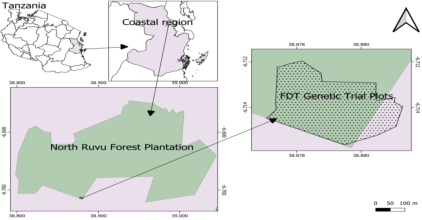
Figure 1. Map of Tanzania showing the location of the study area at North Ruvu Forest Plantation, Pwani region.
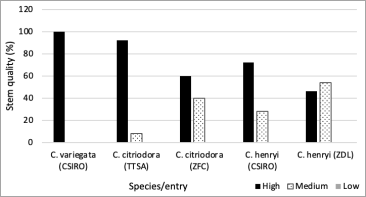
Figure 2. Stem quality distribution of Corymbia species at North Ruvu Forest Plantation, Pwani Region, Tanzania.
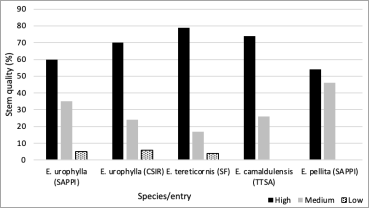
Figure 3. Stem quality distribution of Eucalyptus species at North Ruvu Forest Plantation, Pwani Region, Tanzania.




 Share This Article
 Twitter
 Linked In
 Facebook
 Copy
Copy Download